Will the car of the future
Analysis by Rémi Gancel, Head of Strategy at The Future is NEUTRAL, on the transformation of the automotive industry.
An automotive end-of-life sector that is now industrialised
The image of the “car scrapyard” with vehicles piled on top of one another no longer reflects the reality of the industry. Today, a vehicle’s end of life is part of a structured, supervised, and highly regulated industrial sector. In France, more than 1 million end-of-life vehicles (ELVs) are processed each year across approximately 1,700 authorised treatment centres. Far from being simple storage or destruction sites, these facilities follow a precise industrial process: collection and traceability, depollution, dismantling of parts for reuse or repair, and finally the recycling of materials.
This organisation reflects a profound shift in mindset: vehicles are no longer viewed as waste at the end of their life cycle, but as a genuine source of valuable resources.
From waste to resource: a shift in economic thinking
This evolution reflects a structural transformation of the automotive economy. An end-of-life vehicle is no longer seen solely as a treatment cost, but as a collection of materials and components that can be recovered and reused.
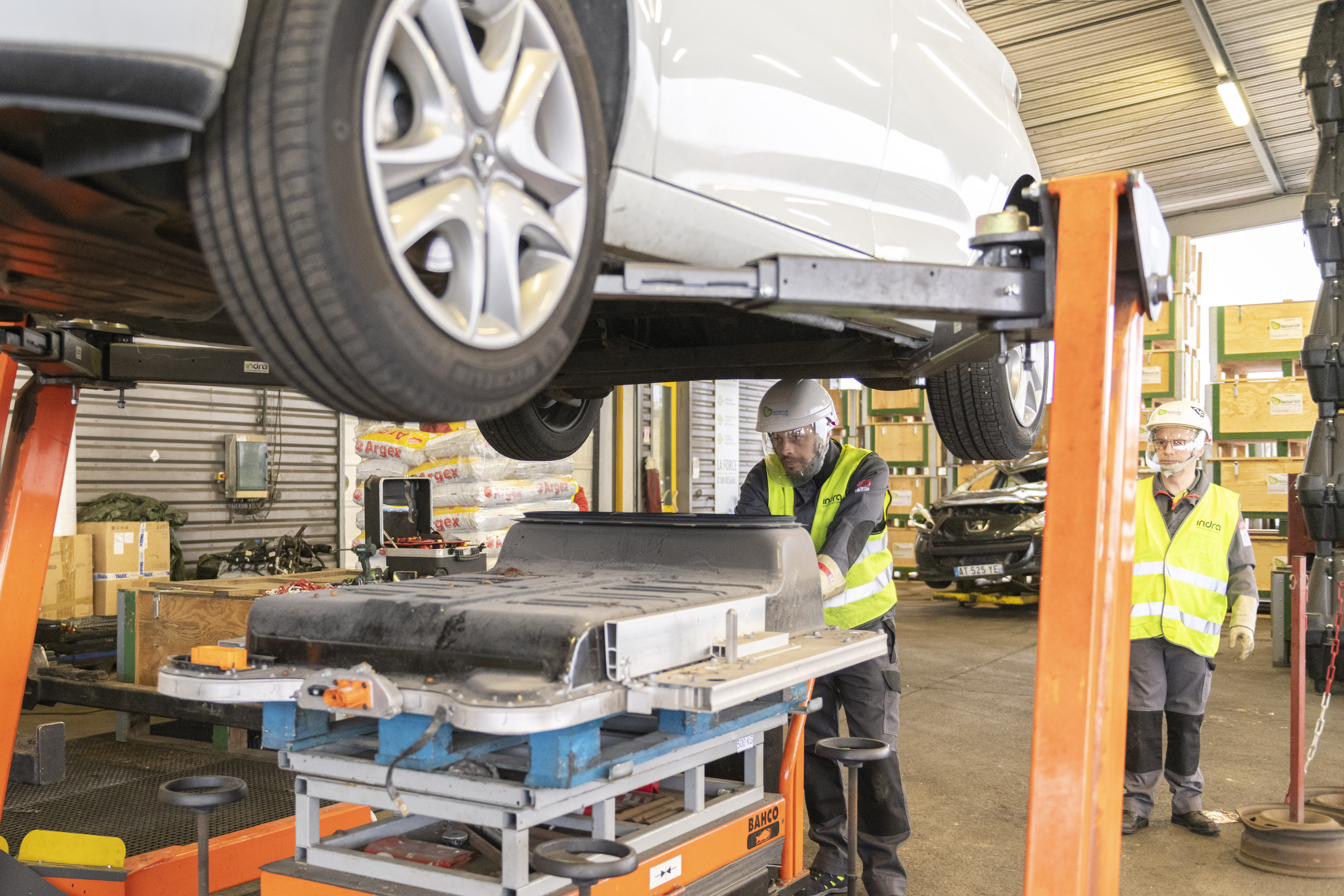
In practice, each vehicle goes through several stages. First, it is tracked and registered to ensure compliant processing and prevent illegal channels. It is then depolluted — a critical step involving the removal of fluids (such as oils and fuels) and hazardous components like batteries. Next comes dismantling, during which still-functional parts are extracted for reuse or repair. Finally, the remaining materials are shredded, sorted, and transformed into recycled raw materials, including steel, aluminium, and plastics that can be reintegrated into industrial production.
End-of-life vehicles, a large-scale “urban mine”
This new approach is based on a key idea: an end-of-life vehicle is an urban mine.
At the European scale, more than 10 million vehicles reach the end of their life each year, representing a massive pool of resources to be recovered. Three main categories of value can be identified. First, materials such as steel, aluminium, copper, or plastics. Second, components, including body parts, mechanical and electronic components that can be reused or remanufactured. Finally, batteries, which are becoming increasingly strategic with the rise of electric vehicles.
In a circular economy perspective, it therefore becomes more relevant to recover these existing resources than to extract new ones. The environmental benefits are also significant: by reusing, remanufacturing, and recycling existing materials, this approach reduces the environmental footprint of automotive production. It helps lower CO₂ emissions, reduces ecosystem damage linked to mining extraction, and decreases water consumption, thereby contributing to mitigating water stress.
Batteries and critical metals: a central industrial challenge
The electrification of the vehicle fleet has profoundly transformed the very nature of end-of-life vehicles. Batteries have become a central issue, both technologically and strategically.
Two main pathways currently exist for their recovery. The first is reuse through second-life applications, where still-functional batteries can be repurposed for stationary energy storage systems. The second is advanced closed-loop recycling, which enables the recovery of critical metals such as lithium, cobalt, and nickel, refining them to a purity level equivalent to virgin materials so they can be reused in the manufacturing of new batteries.
In a context of resource scarcity, these materials represent a major issue of industrial sovereignty.
A still incomplete circularity despite an ambitious framework
From a regulatory standpoint, Europe sets high targets: 85% reuse or recycling and 95% overall recovery of end-of-life vehicles. These targets are broadly met in terms of volumes, but the industrial reality is more nuanced. A share of materials is still directed towards energy recovery, particularly incineration. Some plastics and composite materials remain difficult to process efficiently. Finally, recycled materials are often downcycled into industries that require materials with lower chemical and mechanical performance thresholds than the automotive sector.
In other words, while volumes are significant, the loop is not yet fully closed.
The paradox of new vehicles: little recycled content in modern cars
One of the most striking observations concerns the composition of new vehicles. Despite the existence of a significant supply of recyclable materials from end-of-life vehicles, new cars still contain less than 30% recycled content today.
Moreover, these materials do not primarily come from end-of-life vehicles, but rather from industrial scrap generated during production. The loop between end-of-life vehicles and manufacturing therefore remains only partially closed.
Structural barriers to full circularity
Several factors explain this situation:
- The first is economic: virgin raw materials often remain less expensive than recycled materials, as they require less transformation to achieve the required mechanical properties needed for reintegration into an automotive supply chain.
- The second is industrial and logistical. The collection, sorting, and scaling-up of material flows for recycling remain complex to organise at an industrial scale.
- The third is technological, with increasing complexity in modern vehicles, particularly batteries that combine different chemistries and architectures.
Finally, a major barrier lies in vehicle design itself, as vehicles are not yet systematically engineered to be easily dismantled and recycled.
Reuse and reconditioning: extending the service life of vehicles
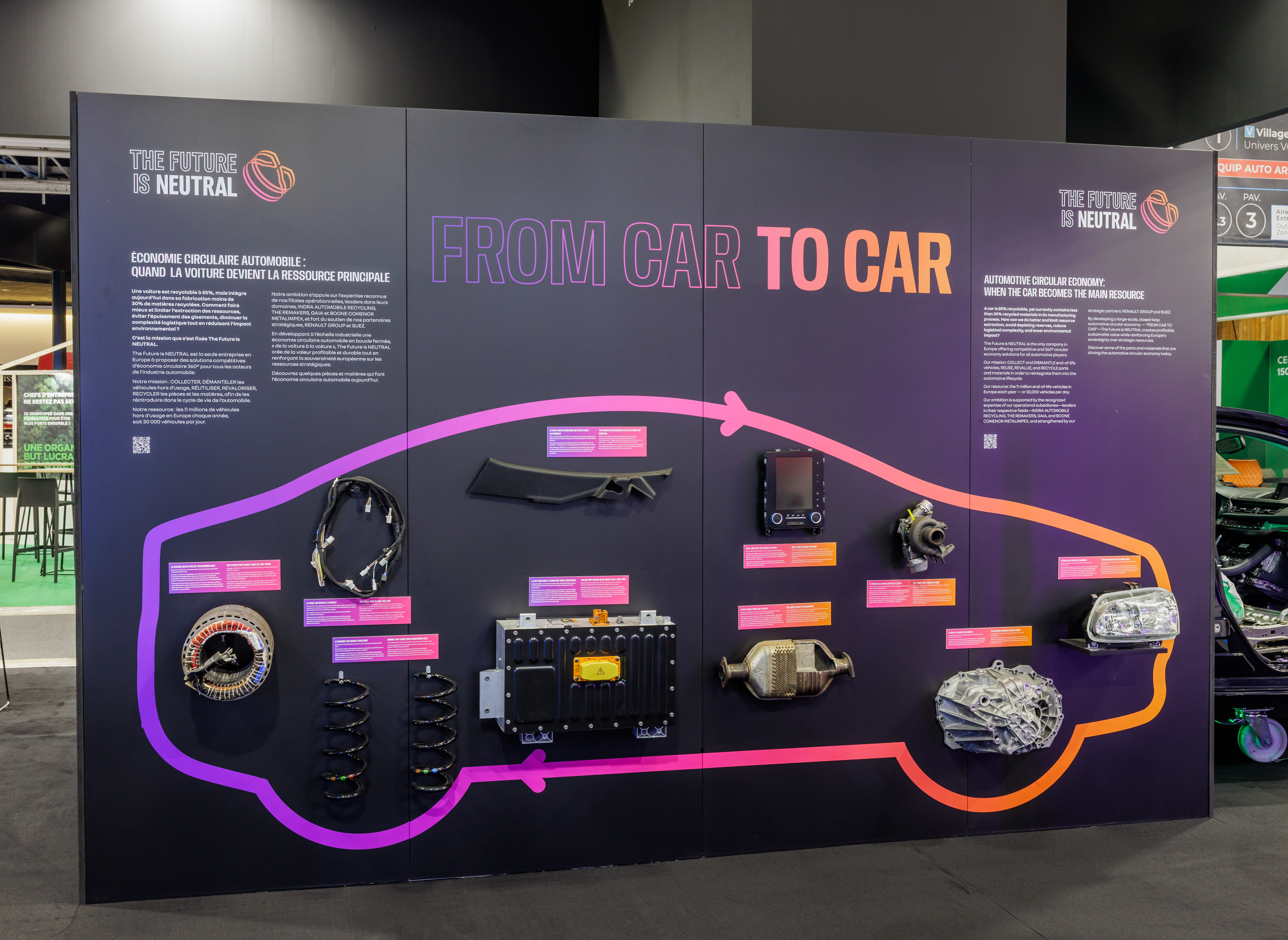
In this context, the reuse of parts is a key lever. Many components can have a second life, whether mechanical parts such as engines or gearboxes, body parts, or electronic components.
Remanufacturing goes even further. It involves restoring a part to like-new condition through a fully industrial process, delivering quality equivalent to new, a manufacturer’s warranty, a reduced cost of up to 30%, and a significantly lower environmental footprint.
An already large-scale industrial sector
At the scale of specialised players, automotive circularity is already an industrial reality.
A network such as The Future is NEUTRAL processes around 250,000 end-of-life vehicles each year through its network. This activity enables more than 10 million reused parts to be put back into circulation, 300,000 parts to be remanufactured in its dedicated plant, and over 2 million tonnes of materials to be recovered.
These figures illustrate a major transformation: circularity is no longer marginal, but is becoming a structuring industrial model.
Towards a vehicle designed as a source of resources
The question is no longer simply about improving the recycling of end-of-life vehicles, but about rethinking the entire automotive lifecycle. The car of the future will not only be recycled after use. It will need to be designed from the outset as a reservoir of materials and components, intended to be efficiently dismantled, reused, and recycled. Only under this condition will the automotive industry be able to truly shift from a linear model to a closed-loop circular model, where each vehicle becomes the resource for the next.

Rémi GANCEL
Head of Strategy – The Future is NEUTRAL
“We have changed the way we look at end-of-life vehicles. Long regarded as waste or a cost, they have become, thanks to the work of dismantling industry players, a genuine industrial resource. They are a concentration of materials, technologies, and components that have already been extracted, already processed, and are available locally. In this logic, the goal is no longer simply to recover value, but to capture as much of it as possible by closing the loop: reusing, remanufacturing, and recycling in order to directly reintegrate these resources into the automotive value chain. The vehicle thus becomes a fully circular system, capable of feeding the next generation of vehicles. Today, we must go further: scale up by accelerating the structuring of the sector.”